

October 8, 2026

Why a Regional Network of Women in Energy Efficiency Matters for Social Cohesion in the Eastern Partnership Countries
Across the Eastern Partnership countries, the energy transition is accelerating. Countries are modernizing infrastructure, aligning with European integration pathways, and investing in green and circular economy solutions.
At the same time, a critical question remains: who gets to shape this transition?
While renewable energy and energy efficiency are often portrayed as progressive sectors, women represent only around 25-32% of the workforce, with even lower participation in senior technical and leadership roles (Publications Office of the EU). This is not only an equality gap. It’s a missed economic opportunity.
A gender-balanced energy sector is more innovative, more resilient, and better equipped to respond to complex sustainability challenges. If the green transition is to be just and inclusive, women must not only participate in it, they must lead it.
Energy systems are not neutral technical structures. They shape employment patterns, regional development, household welfare, and access to opportunity.
If the green shift excludes half of society from leadership, decision-making, and economic opportunity, it risks reinforcing inequality rather than reducing it. That is not only a gender issue, it is a question of social cohesion too.
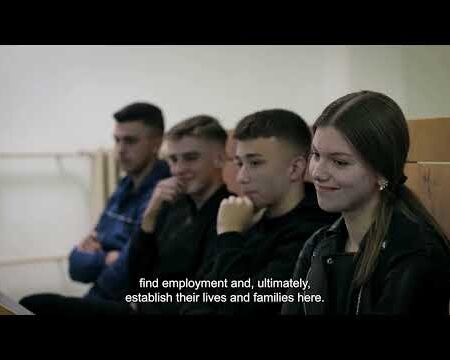
As Valentyna Beliakova, President of Women in Energy Club Ukraine, puts it in one of the episodes of the RECONOMY videocast:
“When we talk about the future of energy, we cannot ignore the future of girls. And what we see, especially in Ukraine and across the region, is that by the time girls reach secondary school, many have already ruled out careers in science, energy, or leadership — not because they have tried and failed, but because no one ever told them that they could. And that’s why Women in Energy Club exists: we make women visible. We are connecting generations. We are showing that energy careers are not just open for men, but they are fully open for women — and they need women.”
Why now?
The momentum for change is here.
The shift from a linear “take-make-dispose” model toward a circular economy is expected to generate more than 6 million jobs globally by 2030. This transformation offers unprecedented opportunities to redesign industries, supply chains, and labor markets.
Yet structural barriers persist. Women continue to face limited access to technical training, leadership pipelines, and decision-making spaces in the energy sector.
At the same time, the broader regional political and societal context is becoming increasingly challenging for gender equality. In such a climate, passive inclusion is not enough. Proactive, collective action is required.
And social cohesion cannot be taken for granted. Energy efficiency and green reconstruction are not only climate measures, they are instruments for stability, rebuilding trust, and creating shared economic opportunity. But this will only happen if inclusion is deliberate. This is why the establishment of an independent regional network of women in the energy efficiency sector is both timely and strategically important for strengthening collaboration, peer support, and collective voice across the region.
Moving beyond the “women’s add-on” narrative
A persistent misconception frames gender inclusion as a soft, optional social agenda.
In reality, gender equality is a structural driver of economic and technical performance.
When gender is treated as a compliance requirement or a CSR checkbox, markets lose out. Projects become misaligned with user needs. Talent pipelines remain narrow. Skills shortages persist.
Similarly, token representation like “we have women in HR, that’s enough” does not create systemic change. Meaningful transformation requires a critical mass of women across engineering, management, entrepreneurship, and policymaking roles.
A gender-inclusive energy transition is not a cost. It is a competitive advantage.
What the Regional Network will do
The establishment of an independent regional network of women in energy efficiency across Armenia, Moldova, and Ukraine is therefore not only timely, it is strategic.
- Build a regional network of women in energy efficiency — consisting of women’s associations across Armenia, Moldova, and Ukraine — to share experiences, opportunities and best practices in addressing common challenges.
- Amplify visibility of women-led and gender-sensitive EE solutions so that businesses, investors, and policymakers begin to see gender diversity as a strategic asset.
- Promote capacity-building, mentorship, and peer support for women engineers, entrepreneurs, managers and innovators.
- Advocate for policy and industry standards that embed gender equality into energy transition plans, recruitment, training, work conditions, and leadership pipelines.
- Facilitate data collection, research and monitoring — gender-disaggregated data, impact assessments, and evidence to track progress.
Why a Regional Approach is a Strategic Advantage
Single-country initiatives often remain fragmented and isolated.
A regional network multiplies influence.
By pooling lessons learned, aligning strategies, and building cross-border mentorship and mobility pathways, the network can amplify its voice at European and international levels.
Regional collaboration also reduces duplication of effort and accelerates innovation. Instead of reinventing solutions country by country, members can build on shared knowledge and scale what works.
In a time of rapid transformation, collective regional action strengthens resilience.
When to expect?
Currently network’s mission, vision, values framework, financial sustainability strategy and governance structure are at a finalization stage, and the launch is expected in Q3 this year.
Meanwhile please follow the work of:
Women in Energy and Climate Armenia
Authors


Nataliia Koshovska
Sabin Selimi
Related Content
October 8, 2026

October 5, 2026
Related Content
October 8, 2026
October 5, 2026


Comments (0)