
October 8, 2026


When Algorithms Hire: Can AI Ever Be Truly Fair?
The promise of neutrality
As a GESI advisor, I initially embraced AI in recruitment as a long-awaited ally – something that could cut through bias, reduce favoritism, and bring a sense of fairness to hiring decisions. On the surface, it promised objectivity. But the deeper I looked, the more complicated the picture became. What seemed like a neutral tool often mirrors the very inequalities it was meant to correct. Instead of eliminating bias, these systems can quietly reproduce it.
AI tools in recruitment promise neutrality. In practice, they often inherit the past.
Algorithms reproduce historical inequalities.
They learn from historical hiring data that is shaped by unequal access and dominant groups. So, they begin to favor profiles that look familiar. Small signals can tip the scale: a phrase, an activity, even a gap in a CV. Amazon once scrapped an AI hiring tool after it systematically downgraded women’s résumés, because that’s what the past had taught it to do.
Bias doesn’t need explicit labels. Gender can be inferred from clues like “women’s chess club.” Careers can be penalized for interruptions (whether it is a parental leave, recovery after an injury or, displacement due to war or climate hazard) because algorithms reward uninterrupted trajectories.
The power of a name
Names may seem like a small detail, but they consistently shape hiring outcomes. A landmark experiment showed that identical résumés with “White-sounding” names received about 50% more callbacks than those with African American–associated names.
This pattern persists across time and contexts. Meta-analyses confirm that majority-group candidates continue to receive significantly more responses, even when qualifications are equal.
Recent large-scale studies show similar trends: applicants with locally familiar or majority-group names often receive up to twice as many positive responses as those with ethnically distinct names.
Names often can signal migration background, ethnicity, or religion, and this bias has direct implications for social inclusion. It reinforces barriers for candidates from immigrant and minority communities, even in formally regulated labor markets. Without safeguards, AI risks embedding these patterns more deeply making discrimination less visible, but no less real.
When language becomes a signal
In general, language, too, becomes a signal. Words like supportive or collaborative appear more often in women’s résumés; leader or competitive in men’s. If an algorithm equates leadership with a narrow vocabulary, it quietly undervalues equally capable candidates who speak differently.
The risks of AI-scored interviews
The risks deepen in AI-scored video interviews. Systems evaluate tone, facial expression, even “charisma.” But communication styles vary. Neurodivergent candidates, or those shaped by different cultures, may be misread. Evidence suggests such assessments are often unreliable and raise concerns that they border on pseudoscience.
Age bias follows a similar pattern. Graduation dates or visual cues can signal age, leading to lower “employability” scores for older candidates.
And over time, these systems reinforce themselves. Biased decisions become new training data. Non-traditional careers are filtered out.
Removing bias from talent and recruitment
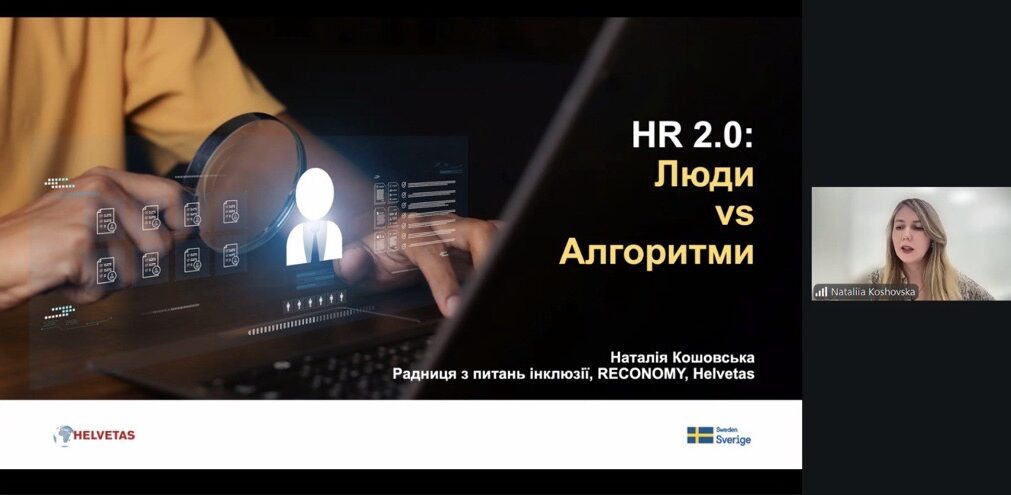
As part of its RECONOMY program, Helvetas is supporting WECU in delivering a targeted course for HR professionals from energy and construction sector companies on unbiased recruitment. One of the key discussion modules in this course focuses on algorithmic management. In a nutshell, while algorithmic tools can bring efficiency and consistency to hiring processes, they also carry significant risks, including bias, discrimination, and the erosion of trust, particularly when algorithms are trained on historically imbalanced data. That’s why safeguards matter such as human oversight, bias audits, transparent design, inclusive data practices. Regulations like the EU AI Act now require human oversight in systems that shape employment decisions now.
Some simple shifts can make a difference:
- Use inclusive language in job descriptions.
- Diversify interview panels.
- Screen résumés anonymously at early stages.
- Apply clear, standardized evaluation criteria.
- Regularly audit AI tools for bias.
- Broaden sourcing channels beyond traditional networks.
- Value unconventional career paths and informal experience.
- Train recruiters to recognize unconscious bias.
- Use structured interviews instead of free-form ones.
- Track hiring outcomes across groups.
- Don’t leave final decisions to algorithms alone.
In this landscape, HR’s role is changing significantly. HR becomes the steward of humanity inside automated systems, balancing tensions: efficiency and empathy, standardization and individuality, data and ethics.
In practice, that means:
- Testing algorithms for fairness and monitoring their impact.
- Embedding AI ethical principles into HR processes.
- Acting as a translator between people and machines ensuring that decisions can be explained and challenged.
Because the question is no longer whether we use AI in hiring, but how human we remain while doing so.
Authors

Nataliia Koshovska
Related Content
October 8, 2026

October 5, 2026

Related Content
October 8, 2026
October 5, 2026


Comments (0)