January 22, 2026
To enable women and youth, including the most disadvantaged and excluded, to benefit from economic opportunities by increasing their income and taking up decent and green jobs, inclusively and sustainably.


TRENDING TOPICS
Latest Posts
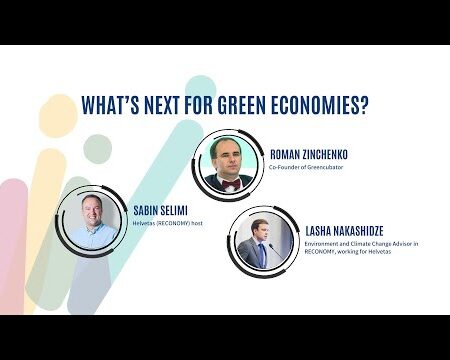

HELVETAS Swiss Intercooperation partnered with the Swedish International Development Cooperation Agency (Sida) to facilitate an inclusive and green economic development program in the Eastern Partnership and the Western Balkan regions. The name of the program, RECONOMY, stands for ‘starting afresh’, revitalizing the transitioning economies in the two regions.
The core of RECONOMY is using current knowledge and practices and encouraging learning and sharing between countries. The program accomplishes this by involving a variety of stakeholders, including public institutions, nonprofits, academia, and businesses. While doing so, the program focuses on common issues that countries of both regions face as well as shared actors that may step up and support systemic improvements.
Since RECONOMY acknowledges that people live in countries, not regions, the program looks at local-regional processes and relationships. Without a place-sensitive frame of view, development efforts that ignore these facts frequently fall short.
RECONOMY places a high priority on the “triple dividend,” or the addition of
Social, Economic and Environmental values.

To enable women and youth, including the most disadvantaged and excluded, to benefit from economic opportunities by increasing their income and taking up decent and green jobs, inclusively and sustainably.
The members of our program facilitation unit are spread across the Eastern Partnership and the Western Balkan regions.




RECONOMY relies on implementing partnerships to bring about large-scale and sustainable change. Therefore, partnerships are important to our implementing model.


The rationale for regional value addition is addressing problems and responding to opportunities where there are commonalities or similarities like the problem across countries. It is also possible that RECONOMY may replicate interventions in one country based on the learning from that intervention in a different country.
Creating a shared understanding of development philosophy – for sustainable and scalable impacts through facilitation – is at the core of RECONOMY. We stimulate changes for more facilitation roles of development organizations by engaging with local and regional conveners.
We map out individual countries, while at the same time having a regional perspective. In other words, the ‘national-regional’ dynamics and nexus will serve the process of identifying and testing ideas that will add benefits to more countries in the region in terms of new knowledge, shared experiences, and enhanced capacities through cooperation and a strong sense of shared interests. The focus is in line with the changing nature of global challenges and opportunities that countries in the region also face - from disruptive technologies for automation, globalization, and the aging workforce. The challenge is to link and leverage these potentials in new and different ways.
The region's pressing problems are far too complex to be addressed by a single sector and an actor in a single country. We see RECONOMY as a multi-stakeholder initiative, involving private sector enterprises, public sector institutions, academia, and civil society organizations. While the region is diverse, it also shows common challenges and opportunities. RECONOMY works to improve the vertical flow of information about economic development, including such questions as performance monitoring and inclusive benefits.
People do not live in the 'region', but in different countries. A large diversity of local partners and ideas contributes to increased capacity and local ownership as well as the generation of more innovative ideas. We do not directly support actors in the different systems, but work through partners to facilitate solutions that have a high likelihood of ownership and scale beyond the life span of RECONOMY. On a micro-level, we work with private sector businesses in the selected markets/economic sectors, commercial service providers, as well as with civil society organizations. On the meso-level, we work with public organizations like vocational education and training centers, universities, regional development agencies, free trade zones. The policy and business enabling environment dialogues deal with the improvement of the macro-level framework conditions.
Market Systems Development (MSD) is a development approach which is applied by the Swedish International Development Cooperation Agency (Sida) and HELVETAS Swiss Intercooperation.
MSD is an approach that aims to make the market systems function better in order to increase the quality of life for people in need through the following:
We try to understand where market systems are failing to address the needs of the vulnerable and disadvantaged groups in society. We try to understand what constitutes systemic change and how change happens in (market) systems and how does that influence the design and implementation of our program.
We stimulate, but do not displace, market functions or actors. We encourage dialogue with stakeholders and actors, pointing out and discussing new opportunities. We support new linkages between actors from private and public sectors as well as civil society.
We encourage our private partners with skill and will to grow their business inclusively and collaborate with public actors towards frame conditions that ease inclusive and green economic development.
We deliver sustainable outcomes through competitive market actors achieving inclusive and green economic development. We apply a market-driven approach, focusing on identifying existing challenges and demands on the market, assisting market actors in overcoming the challenges and creating more economic opportunities.